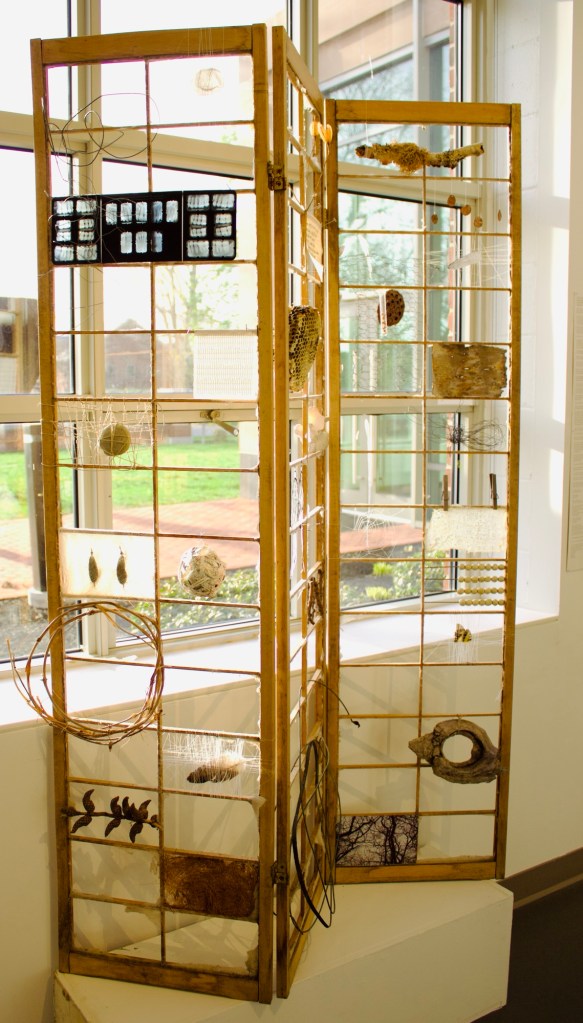
mixed media on found wooden screen
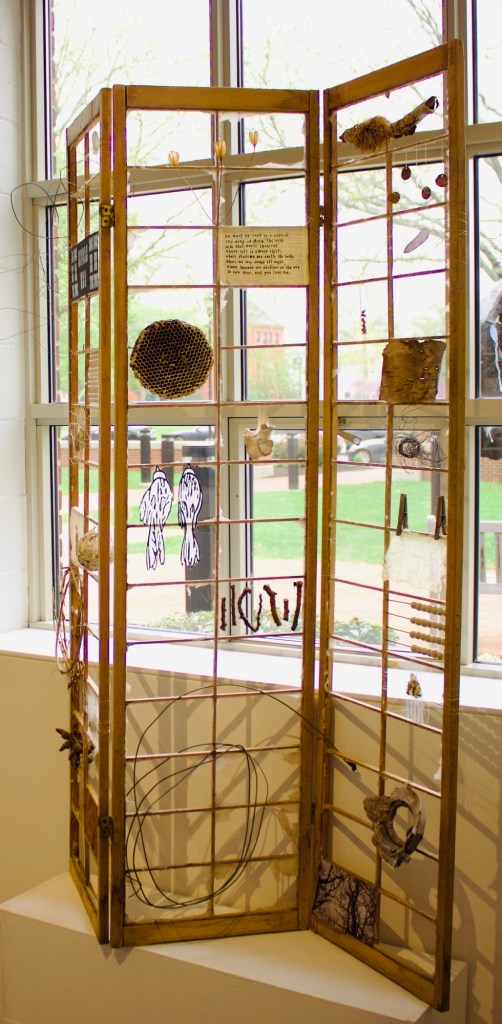
Insomnia
The moon in the bureau mirror
Looks out a million miles
(and perhaps with pride, at herself,
but she never, never smiles)
far and away beyond sleep, or
perhaps she’s a daytime sleeper.
By the Universe deserted,
she’d tell it to go to hell,
and she’d find a body of water,
or a mirror, on which to dwell.
So wrap up care in a cobweb
and drop it down the well
into that world inverted
where left is always right,
where the shadows are really the body,
where we stay awake all night,
where the heavens are shallow as the sea
is now deep, and you love me.
Elizabeth Bishop
Accompanying Artist Statement
In my experience the visual artist, accustomed to working with imagery, materials and ideas, does not much enjoy the task of using words to convey her intention in the obligatory artist’s statement. Trying to compose one that honors both my own work and the work of one of the most revered poets of the 20th C, is therefore particularly daunting. But because I believe that a written statement can be vital, (and, at the very least, curious or amusing), I offer these thoughts for your consideration.
While seeking inspiration for my art in literary reference books, before I even knew her name, I frequently came across excerpted poems by Elizabeth Bishop. Initially I was drawn to Bishop’s work simply because the titles of her volumes (North and South, Questions of Travel, Geography III) suggested a preoccupation with place that mirrored my own. One favorite poem, The Map, muses on the relationship between the small paper map itself and the vast territory it describes. About the land mass Bishop writes, “These peninsulas take the water between thumb and finger/like women feeling for the smoothness of yard-goods.” She anthropomorphizes the landscape, pointing to the connection between the infinite and the infinitesimal, a theme that permeates my own work. Bishop, an orphan, moved homes several times during childhood and often communicated a lingering sense of dislocation and homelessness; happily, this is not my biography, but my work does share Bishop’s concern with finding one’s way against a backdrop of uncertainty.
The kinship with Bishop extends, I would like to think, to our mutual attention to detail. Bishop often dwells on images from the northern woods, farms and fishing villages, demonstrating, according to one critic Ernest Hilbert, “her belief that no detail is too small to be of significance.” He continues, “Bishop’s poetics is one distinguished by tranquil observation, craft-like accuracy, care for the small things of the world, a miniaturist’s discretion and attention.” She was known for laboring over the selection of each word, sometimes taking months, even a decade to complete a single poem to her own satisfaction. Yet, in spite of the monumentality of her efforts, the poems, in my opinion, are quiet ‘anti-monuments,’ recordings of and musings upon otherwise insignificant details of daily life. As she wrote in the last line of her poem The Bight, (which she chose for the epitaph on her gravestone in Worcester), “untidy activity continues, awful but cheerful.” I think of my own work in this way—a selection of fragile, beautiful (to me) but unremarkable materials, which I knot, sew, embed, and juxtapose with patient, laborious, attention. They are quiet gestures, the by-product of a meditative practice, of ‘mindfulness.’ I hope that Elizabeth Bishop would have liked them.
2007

 catherinewatkins.com